
Outlook
Part of Why the podcast advertising outlook for England keeps shifting
How to model a podcast advertising budget
Model a podcast advertising budget with scenario ranges, cost-per-acquisition steps, review triggers and the UK VAT threshold.
What to take away
- Treat the outlook as a set of scenarios, not a single forecast. Build a base, a squeeze and a stretch case, each with its own cost per thousand and conversion assumption.
- Watch three update triggershost-read price movement, measured conversion rates and the VAT registration threshold. That sits at £90,000 of taxable turnover in a rolling 12-month period, per Register for VAT: When to register for VAT.
- Budget in pounds sterling and hold a contingency for inventory that sells out before your campaign lands.
- Rewrite the outlook whenever a trigger moves, not on a fixed annual cycle.
Set the scenario frame first
Choose the variables you will flex
A useful outlook flexes four variables. They are the price paid per thousand downloads, the share of inventory you can book, the conversion rate you assume and the network fee charged on top.
Variables to Flex
Variable
- Price per thousand downloads
- £18
- Share of inventory booked
- —
- Conversion rate assumed
- —
- Network fee on top
- —
Current Value
- Price per thousand downloads
- £24
- Share of inventory booked
- —
- Conversion rate assumed
- —
- Network fee on top
- —
Squeeze Case
- Price per thousand downloads
- —
- Share of inventory booked
- —
- Conversion rate assumed
- —
- Network fee on top
- —
Stretch Case
- Price per thousand downloads
- Share of inventory booked
- Conversion rate assumed
- Network fee on top
Write each variable down with its current value and a range. For example, a team paying £18 per thousand downloads might model a squeeze case at £24. Use a named source for every figure: your own rate card, an Acast or Audioboom quote, or IAB UK data.
Anchor the range in the 2019 to 2023 IAB UK growth record
Podcasting has moved through distinct phases since 2005, and Apple's retrospective on 20 years of podcasts sets out how the format grew and how advertising evolved alongside it. Use that timeline to sanity-check any claim that growth is unprecedented.
For a hard benchmark, use IAB UK's Digital Adspend series, which recorded UK podcast advertising at £91m in 2023, up 23% on 2022. Treat a claimed doubling in one year as exceptional until a named source supports it.
Use this historical benchmark to put your scenarios in context, but do not treat past growth as a forecast for future rates or inventory.
Build the numbers
Run the cost and return steps
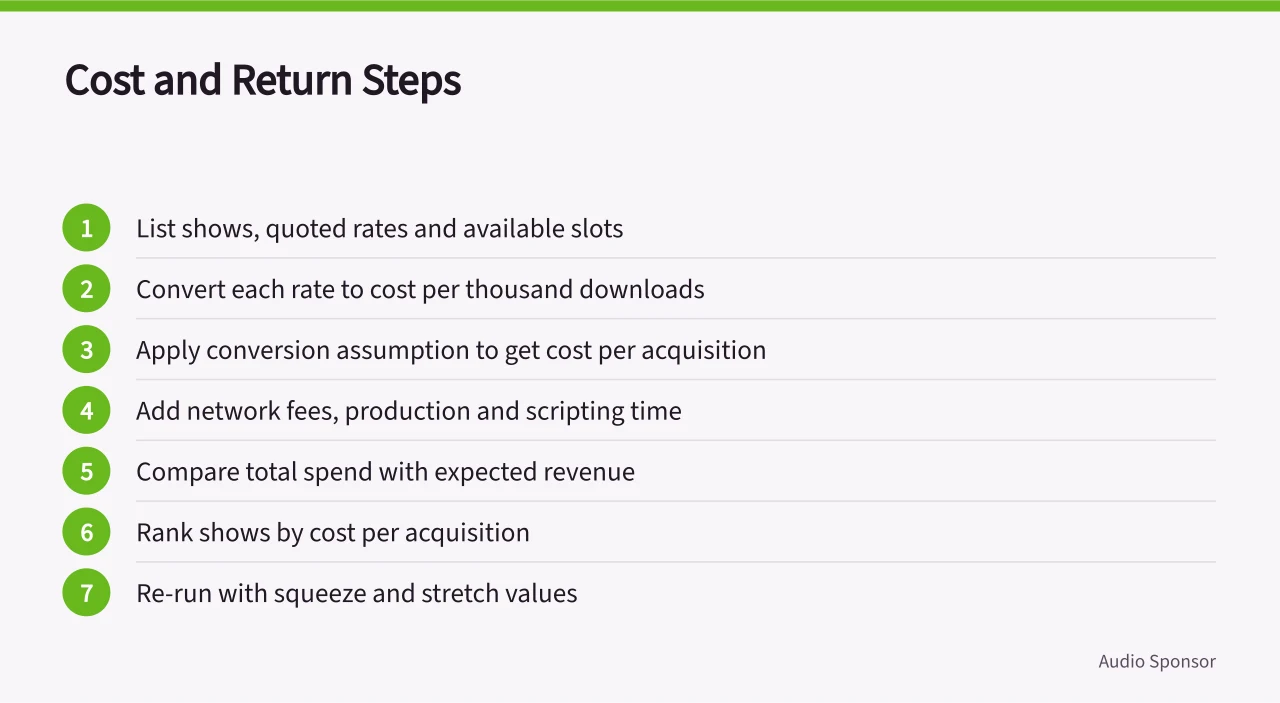
- List every show you might buy, with its quoted rate and available slots.
- Convert each rate to a cost per thousand downloads using the show's published figures.
- Apply your conversion assumption to get a cost per acquisition for each show.
- Add network fees, production costs and host-read scripting time.
- Compare total spend with the revenue you expect the campaign to influence.
- Rank shows by cost per acquisition, not by audience size.
- Re-run the sheet with your squeeze and stretch values before you sign anything.
Worked example: a show quoted at £18 CPM with 100,000 downloads costs £1,800. At a 0.5% conversion rate that is 500 customers, so cost per acquisition is £3.60 before fees. A 15% network fee adds £270, giving a total of £2,070 and a cost per acquisition of £4.14.
Check the regulatory and tax edges
Advertising claims in host-read slots still fall under the CAP Code. The ASA resource library holds searchable guidance you need if a script makes a health, financial or comparative claim.
On the tax side, once taxable turnover passes the threshold in any rolling 12-month period you must register. That changes the margin on every ad sale and agency invoice, so it belongs in the outlook rather than a separate finance conversation.
Decide what triggers a rewrite
Name the triggers and the owner
Pick three measurable triggers and give each one an owner. A trigger might be a 10% move in the average rate you are quoted, measured conversion falling below your base case, or turnover crossing the VAT threshold.
Keep the model honest as tools change
If your buying or reporting setup changes, revisit the assumptions about placement, reporting and fees before you lock the forecast.
An outlook is only as good as its assumptions. Review them quarterly.
Common questions
How often should the outlook be updated?
Review assumptions quarterly and rewrite immediately when a named trigger fires. An annual rewrite alone leaves you planning against stale prices.
Does the VAT threshold apply to all podcast ad income?
It applies to your taxable turnover across the business, not just podcast income. Check the GOV.UK guidance for the current threshold and the rolling 12-month test.
Should the outlook cover England only or the whole UK?
Advertising regulation and tax rules apply UK-wide, so build the numbers on that basis. Regional differences show up mainly in inventory availability and pricing.
What is the biggest planning error?
Committing to rates before modelling cost per acquisition. Rank shows by converted cost, not by download count.