

Reviews
Podcast advertising reviews explained for confident buying decisions
How podcast advertising reviews and comparison methods work in practice, covering scoring, due diligence, platform changes and the checks that keep spend defensible.
What to take away
- A podcast advertising review is a documented comparison of shows, networks or agencies against fixed criteria, not a personal opinion about a favourite presenter.
- Scoring works best when audience data, ad delivery, brand safety and commercial terms are weighted before any sales conversation begins.
- Due diligence should include enforcement records as well as audience claims, because a cheap rate card means little if the advertiser behind it has a history of deceptive claims.
- Platform changes, including new Apple Podcasts features, can alter how ads are delivered and measured, so every review needs a review date.
- Keep a written record of every comparison so a later challenge from finance or a regulator can be answered quickly.
A podcast advertising review is a structured assessment of the shows, networks or agencies you might buy from. It scores them against criteria you set in advance. This definition matters: many buying decisions here still rely on instinct, a rate card and a friendly email. Reviews replace that instinct with evidence for a finance director, client or compliance officer.
This guide sets out how reviews and comparison methods should work as the market moves into 2027. It covers scoring, weighting, the data worth paying for, and checks to protect you if a campaign underperforms.
For a repeatable process rather than a one-off decision, start with the podcast advertising selection checklist in England. It turns the headings below into a working document.
A review is not a verdict on a presenter's talent. It is a record of what you checked, what you found and what you decided. That record is what makes the process defensible months later.
Choosing review criteria and weighting them
Choosing criteria before you look at rates
The order of operations decides whether a review is honest. Criteria first, evidence second, rates last. If you see the price before agreeing what matters, every other judgement bends towards justifying the number you already want to pay.
Review order of operations
- Choose criteria first
- Collect evidence second
- Look at rates last
- Weight criteria before data
- Separate gates from scores
- Name owner, reviewer, approver
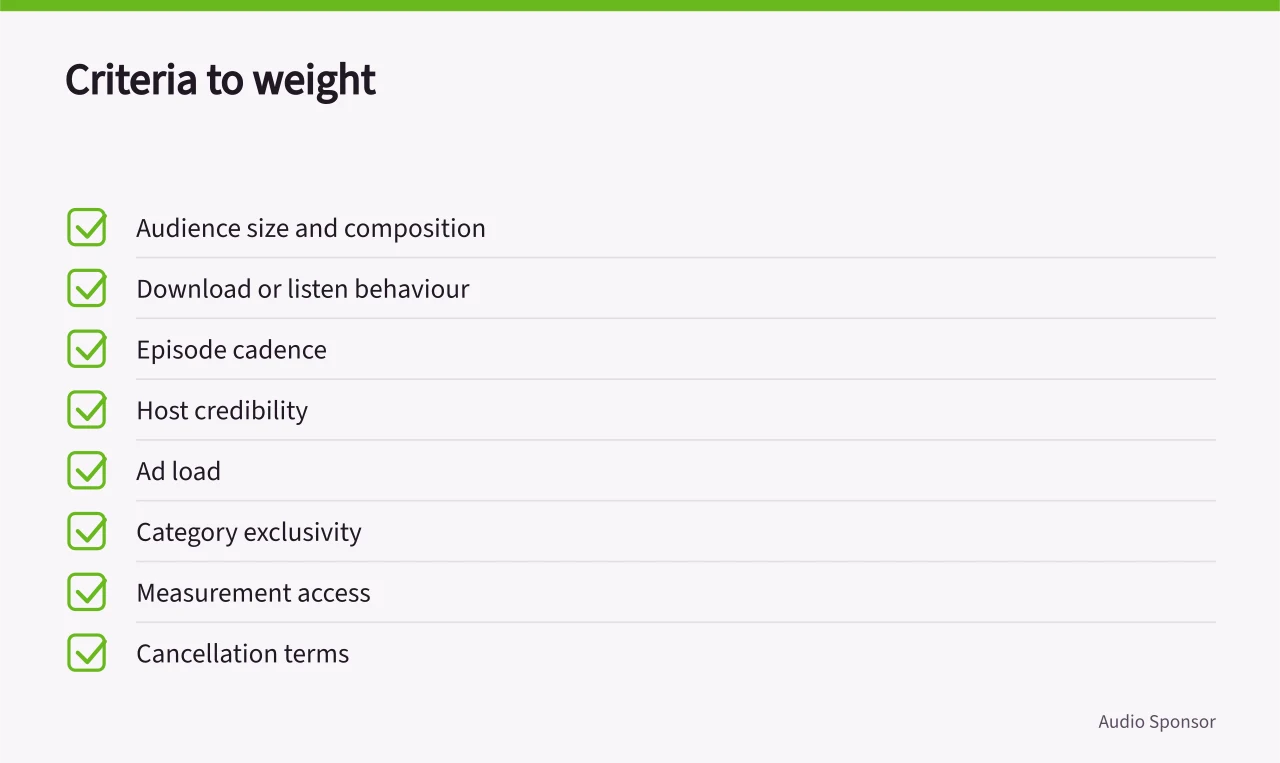
A workable set of criteria covers audience size and composition, download or listen behaviour, episode cadence, host credibility, ad load, category exclusivity, measurement access and cancellation terms. Weight them before you collect data. A brand selling business software will weight audience composition heavily. A consumer brand chasing reach may weight cost per thousand listens instead.
Write the weights down. A simple percentage split across six criteria is enough. The point is that two people reviewing the same show should reach roughly the same score.
Separate criteria into gates and scores. A gate is a pass or fail test. The show must publish on a predictable schedule, or the network must offer post-campaign reporting. Gates remove options. Scores rank whatever survives.
Keep the list short enough to use. Eight weighted criteria and two gates is a practical ceiling for a small team. Add more and the document stops being read.
Decide who owns the review before it starts. One named owner, one reviewer and one approver is enough. Committees produce long documents and slow decisions, and podcast inventory rarely waits.
Define what each score means before you start awarding them. A five on audience composition might mean a verified, dated figure with a geography split. A three might mean a publisher figure with no independent check. A one means no figure at all. Without those definitions, two reviewers will disagree.
Test the criteria on a show you already know well. If the scoring produces a result you disagree with, the weights are wrong. It is better to find that out on a familiar example than on a live buy.
Scoring, weighting and what a good score looks like
Score each criterion out of five, multiply by the weight, and total. That gives a comparable number across very different opportunities. The method matters more than the arithmetic. Anyone handling gaps in the data should read how to document review methodology, because the notes matter as much as the score.
| Criterion | Suggested weight | What evidence counts | Red flag |
|---|---|---|---|
| Audience composition | 25% | Publisher analytics, survey data, geography split | Claims with no source or date |
| Delivery and measurement | 20% | Host-read versus dynamic insertion, reporting access | No post-campaign reporting offered |
| Brand safety and content fit | 15% | Recent episode review, category conflicts | Unreviewed back catalogue |
| Commercial terms | 15% | Rate card, exclusivity, make-good policy | Verbal promises only |
| Advertiser due diligence | 15% | Enforcement records, company filings | Named on a non-compliant list |
| Operational fit | 10% | Lead times, creative approval, invoicing | No named contact |
The table is a starting point rather than a standard. Adjust the weights to your category.
A score of 4 or above on audience composition with a 2 on measurement is a common pattern. It usually means the show is popular but the reporting is thin, so you are buying reach without proof of delivery. Decide in advance whether that combination is acceptable, and at what price.
Treat missing evidence as a low score, not a neutral one. A blank field is not evidence of quality. If a publisher cannot supply a geography split, score the audience criterion as though the split is unknown, and say so in the notes.
Set a minimum total before you start looking. If the threshold is 3.5 out of 5, anything below it fails regardless of how keen the sales team is. Thresholds protect you from the enthusiasm of a good pitch.
Record the score for the runner-up as well as the winner. When the first choice falls through, or the price rises, you already have a second option on file with the work done.
Here is a worked example using those weights, with scores out of five.
Weight
- Audience composition
- 25%
- Delivery and measurement
- 20%
- Brand safety and content fit
- 15%
- Commercial terms
- 15%
- Advertiser due diligence
- 15%
- Operational fit
- 10%
- Weighted total
- 100%
Business software
- Audience composition
- 5
- Delivery and measurement
- 2
- Brand safety and content fit
- 4
- Commercial terms
- 3
- Advertiser due diligence
- 5
- Operational fit
- 4
- Weighted total
- 3.85
Consumer tech
- Audience composition
- 4
- Delivery and measurement
- 4
- Brand safety and content fit
- 4
- Commercial terms
- 4
- Advertiser due diligence
- 4
- Operational fit
- 3
- Weighted total
- 3.90
Personal finance
- Audience composition
- 3
- Delivery and measurement
- 2
- Brand safety and content fit
- 4
- Commercial terms
- 5
- Advertiser due diligence
- 3
- Operational fit
- 4
- Weighted total
- 3.35
The business software and consumer tech shows clear the 3.5 threshold. The personal finance show fails at 3.35, even with the strongest commercial terms on the sheet. That is the point of weighting before you rank.
Check the scoring sheet before you use it on a live decision. Two reviewers scoring the same three shows independently should land within half a point of each other. If they do not, the definitions are too loose.
Due diligence and platform checks
Enforcement records as a screening tool
Due diligence is where reviews earn their keep. Before committing budget, check whether the advertiser or agency you are dealing with has form. The US Federal Trade Commission publishes warning letters setting out enforcement priorities for deceptive advertising, which is useful context for any campaign making health, earnings or performance claims.
Three due diligence screens
- FTC warning letters on deceptive advertising
- ASA non-compliant online advertisers list
- ICO enforcement actions for marketing breaches
- Check advertiser and agency or network
- Run before first call, under an hour
In the UK, the Advertising Standards Authority names non-compliant online advertisers whose ads have been referred for further action. A brand appearing there is a material fact in any review, regardless of how attractive its media budget looks.
Data protection enforcement is the third screen. The Information Commissioner's Office maintains a register of enforcement actions showing penalties for marketing breaches. If a prospective partner has been penalised for unlawful marketing, treat the rate card as secondary.
Run all three checks before the first call, not after the contract is signed. They take under an hour and they change the conversation.
Screening applies at two levels. Check the advertiser whose product will be read out, and check the agency or network selling the inventory. A clean brand bought through a seller with a poor record still carries risk for your compliance file.
Company filings are a useful companion to enforcement records. Accounts and director history are cheap to check and occasionally reveal a business that has been renamed or restarted.
Record the outcome even when the check is clean. A dated note saying nothing was found is worth more than an unwritten memory when questions arrive. Diarise the check to repeat annually.
If a check does surface something, escalate rather than quietly drop the option. The decision to proceed, with conditions, belongs to whoever owns the risk. Write those conditions into the contract.
Cross-border checks matter too. A US warning letter can be relevant to a UK campaign if the same claim will run here, and a UK ruling can follow an advertiser into other markets.
Counterfeit risk and platform changes
The products being advertised deserve the same scrutiny as the people selling them. Categories adjacent to counterfeits, from cosmetics to consumer electronics, carry legal risk for the publisher and the brand. The government's guidance on intellectual property crime and infringement is the starting point for understanding where the lines sit.
Platform behaviour is the other moving part. Apple has documented new features in iOS 26 for Apple Podcasts that affect how listeners encounter and interact with shows. Anything that changes listening behaviour can change ad delivery and completion rates, so a review written before a platform update should be dated and revisited.
Agencies are not exempt from this work. The podcast advertising agency reviews in England article covers how to assess an intermediary's own claims, including whether its reporting is first-party or resold.
Write platform changes into a simple log with a date and a one-line description. When completion rates move, the log answers the first question anyone asks, which is what changed.
Ask for substantiation on any claim the ad copy makes. Health, earnings and environmental claims all carry regulatory weight. If the advertiser cannot produce evidence for a claim, the safest place for that claim is outside the script.
Creative approval sits alongside platform checks. Ask who signs off ad copy, how long that takes, and what happens if a script is rejected. A campaign delayed past its flight dates is a wasted buy.
Keep a short written policy on categories you will not advertise. A policy agreed in advance is easier to defend than a decision made under pressure during a sales call.
Comparing options and setting a review refresh cadence
Building a like-for-like comparison
Comparison only works when the units match. A host-read slot on a weekly show is not the same product as a dynamically inserted pre-roll across a network, even when both are quoted as a cost per thousand. Normalise before you rank.
Networks and sales houses such as Acast, Audioboom and Global's DAX sell the dynamic type, and their rates are not like-for-like with a direct host-read deal.
Like-for-like option comparison
Mid-tier show
- Monthly cost
- £400
- Quoted rate
- Record
- Expected listens
- Record
- Measurement source
- Record
- Exclusivity period
- Record
- Make-good terms
- Record
Two smaller shows
- Monthly cost
- £400
- Quoted rate
- Record
- Expected listens
- Record
- Measurement source
- Record
- Exclusivity period
- Record
- Make-good terms
- Record
Ask every supplier for the same five figures: quoted rate, expected impressions or listens, measurement source, exclusivity period and make-good terms. Where a figure is unavailable, record it as unavailable rather than estimating. An estimate in a comparison table becomes a fact in a board paper.
For a worked example, a team paying £400 a month for a mid-tier show might compare that against £400 spread across two smaller shows with better audience fit. The right answer depends on the weighted scores, not the headline price.
The podcast advertising product comparison in England sets out how to lay these options side by side without mixing formats.
Typical UK rate cards quote host-read spots at about £15 to £40 per thousand listens, with premium titles above that. At £20 to £40 per thousand, £400 a month buys roughly 10,000 to 20,000 listens. The comparison above is about where those listens sit, not the headline figure.
Put the comparison in a single table with one row per option and one column per figure. Keep the scoring sheet separate from the price sheet. When the two are merged, price tends to win.
State the assumptions at the top of the table. If listen figures assume a full campaign run with no cancellations, say so. Assumptions that live only in someone's head cannot be audited.
Check exclusivity and category conflict before ranking anything. A competitor may already hold category exclusivity on a show you want, and no discount compensates for an ad that cannot run.
Make-good terms deserve their own column. If a campaign underdelivers, a make-good in the same show is worth more than a credit note against future inventory elsewhere.
Weight price explicitly rather than treating it as the tie-breaker. If price carries 20% of the decision, say so, and let the other criteria do the rest.
Keeping audience data honest
Audience claims age quickly. A review built on figures from eighteen months ago may describe a show that has since changed format, host or release schedule. Set an expiry date on every review, ideally twelve months, and re-check the top two criteria when it lapses.
Where you need to go deeper on listener data, including how to interpret survey panels and geography splits, the podcast advertising audience research guide for England explains what publishers can and cannot evidence. Treat any claim without a source and a date as a question, not a fact.
Give every review a named owner in the header. A document with no owner is a document nobody updates, and stale comparisons are worse than none because they carry false authority.
Where a third party measures the show, ask which one and whether the publisher can share the report directly. Resold numbers pass through several hands before they reach a buying table.
Templates to keep on file
Build these three as one-page documents or as tabs in the same spreadsheet:
- A criteria sheetthe eight criteria, their weights, the two gates, and a definition for each score from 1 to 5.
- A comparison tableone row per show or network, the same five figures in every row, and a column for the weighted total.
- A platform-change logthe date, a one-line description of the change, and whether delivery or measurement was affected.
Common questions
How often should a podcast advertising review be repeated?
At least every twelve months, and sooner if a show changes host, format or release frequency. Platform updates that affect listening behaviour are also a trigger for a fresh look.
What is the difference between a review and a comparison?
A review scores one option against fixed criteria. A comparison places two or more scored options side by side using the same units and weights. You need both, in that order.
Do I need to check enforcement records for every advertiser?
Yes, at least at a screening level. The FTC, ASA and ICO registers take little time to search and can surface a problem before money is committed.
Can I rely on a publisher's own download figures?
Use them as one input, not the whole answer. Ask for the measurement source and date, and treat unsourced figures as an open question in your scoring.
In this guide
- How to document podcast advertising reviewsA practical method for documenting podcast advertising reviews: separate claims, evidence and judgement, set review limits, and keep a dated audit trail.
- Podcast advertising: five checks and a bidder scoring sheetUse five checks to assess podcast advertising bids, then score inventory, labelling, data, reporting and commercial terms with a weighted sheet.
- How to run a podcast advertising product comparison without a sales deckA worked method for comparing podcast advertising products in England, including a scoring rubric, due diligence checks and the evidence to demand before signing.
- Why podcast advertising agency reviews need a method you can auditHow to read podcast advertising agency reviews with an auditable method, covering ASA, FTC and ICO sources plus a before and after scoring table for buyers.
- Nine checks for a podcast advertising selection checklistMost podcast advertising selection checklists score the seller's deck, not the evidence. Nine checks force due diligence on consent, IP and claims.