Tools and providers
What the 2026 podcast buying shake-up means for advertising tools and providers
How the 2026 podcast ad shake-up affects Acast, DAX, Megaphone, Podscribe, Magellan AI and Spotify, with fees, limits and UK data rules for media buyers.
What to take away
- Concentration is the story. Spotify closed Chartable and Podsights in 2024. Amazon owns Wondery and ART19, and iHeartMedia owns Triton Digital and Spreaker.
- A realistic UK shortlist runs to five namesAcast, Global's DAX, Spotify's Megaphone stack, Amazon Ads and Triton Digital.
- Fees still split two ways. Percentage deals commonly land at 10% to 20% of media cost. Flat platform licences start around £1,500 a month (illustrative figures).
- Measurement has thinned out as much as ad serving. Podscribe handles attribution, Magellan AI estimates rival spend, and Veritonic tests the audio creative.
- The ICO's broker guidance and the closure of Oracle Advertising in 2024 have narrowed the audience data you can lawfully buy.
Why the buying stack looks different now
The past two years changed how podcast inventory is bought. Host-read slots, programmatic inserts and branded series now sit in the same media plan. Buyers expect one report covering all three, and that expectation reshaped the supplier market.
Spotify is the clearest case. It bought Megaphone in 2020, added Chartable and Podsights in 2022, then closed Chartable and Podsights in 2024. Advertisers who built reporting around those tools had to move to the Spotify Audience Network or find replacements.
Amazon moved the same way. It bought Wondery in 2020 and ART19 in 2021, so hosting, insertion and a premium show catalogue sit inside Amazon Ads. SiriusXM owns AdsWizz and sells through SXM Media.
iHeartMedia holds Triton Digital, which runs the Omny Studio hosting platform, and Spreaker. Acast has stayed independent of the big audio owners and still sells its own inventory. Global, owner of Capital and Heart, sells UK digital audio through DAX.
The practical effect for a UK advertiser is that you rarely buy a single tool. You buy a chain: research, planning, insertion, verification and reporting. Each link can come from a different supplier, and each one adds a fee.
That is why shortlists have narrowed. Most teams run four to six suppliers in total, including their existing media agency. Anything longer usually means the brief was never written down properly.
Consolidation has a second effect that buyers notice later. If the same platforms control access to the mid-tier shows on your list, the negotiating advantage sits with them rather than with you. Keep at least one direct publisher relationship alongside any platform deal.
Budget owners have also moved podcast spend into the same line as display and paid social. Finance teams now ask for one invoice format, one reporting cadence and one set of payment terms. Suppliers that cannot match those expectations start pitches on the back foot.
The five layers of a podcast buying stack
Thinking in layers keeps procurement manageable. These are the five that appear in almost every UK buy, listed in the order most teams adopt them.
Five layers of a podcast buying stack
- Audience research and planning
- Campaign planning and booking
- Ad serving and insertion
- Verification and brand safety
- Reporting and measurement
Audience research and planning
This layer answers who listens to which shows and what that audience costs. Edison Research publishes Share of Ear and Edison Podcast Metrics, which cover UK listening. RAJAR measures UK radio and digital audio through its MIDAS service.
Smaller buyers often start with Rephonic, a UK database that filters shows by audience size, or Listen Notes, whose search is free and whose API is paid. Magellan AI scans episodes, detects the ads inside them and estimates what rivals spend.
Podchaser, owned by Acast since 2022, holds credits and contact data. Our podcast advertising audience research guide for England walks through the data sources worth paying for and the ones you can skip.
Research tools matter most when you buy across many small shows. A single top-20 podcast can be assessed by ear. A buy across forty niche shows cannot, and that is where a research subscription earns its fee.
Ask any research supplier how many panel members listen weekly rather than monthly. Sample sizes that look generous often shrink once you filter for the shows on your list.
Campaign planning and booking
This is the layer buyers touch daily: inventory discovery, rate cards, hold management and insertion orders. Acast sells its own network directly. Global sells UK digital audio through DAX. Spotify sells through the Spotify Audience Network, and Amazon Ads sells Wondery shows plus third-party inventory.
Neutrality is the main commercial question here. A planner owned by a publisher will favour that publisher's inventory, however good the interface. Ask directly who owns the platform and how inventory is ranked.
Ask for a live walkthrough of a real buy as well. Tools that perform well on a prepared example often struggle when a buyer adds a show mid-campaign or splits budget across regions.
Ad serving and dynamic insertion
The ad server decides which creative a listener hears. Dynamic insertion swaps a host-read slot for a different message by region or day part, which is what makes podcast buying resemble display buying.
Four platforms cover most of the market: Megaphone, owned by Spotify, ART19, owned by Amazon, Omny Studio, owned by Triton Digital, and AdsWizz, owned by SiriusXM. Acast runs insertion for the shows it hosts.
Two pricing models dominate. Percentage-of-spend deals typically land between 10% and 20% of media cost (illustrative range). Flat licence deals often start around £1,500 a month (illustrative figure). Our podcast advertising best tools in England comparison sets out which platform uses which approach.
Three things break dynamic insertion in practice: creative files outside the accepted specification, missing episode-level metadata, and late delivery of assets to the publisher. Each has a fix, and each fix costs time.
Verification and measurement
Verification suppliers check that impressions reached real listeners and that brand safety rules were followed. Podscribe is the best known third-party option for attribution and works independently of publisher numbers. Podtrac publishes industry rankings and provides certified measurement.
Triton Digital's Podcast Metrics covers networks running on Omny. Veritonic and Barometer measure recall, attention and brand lift. The IAB Tech Lab's podcast measurement guidelines set the download-counting rules that certified suppliers follow, so ask whether a supplier is certified.
This is the layer most likely to be cut when budgets tighten, and the layer a finance director demands after a poor quarter. Decide which side of that argument you are on before procurement starts.
Contracts here often run for a year, so agree the metrics you will act on before signing. Download verification, completion rates and brand-safety flags form the core set. Attention scores add context but rarely justify a contract of their own.
Reporting and attribution
Attribution for podcasts remains imperfect. Podscribe matches conversions to ad exposures, ArtsAI does similar work for audio, and Magellan AI tracks spend rather than sales. Promo codes, dedicated landing pages and post-campaign surveys remain the fallbacks, and none of them is precise.
Export formats matter more than buyers expect. If a platform cannot produce a file your finance team can reconcile, somebody rebuilds it in a spreadsheet every month. That hidden cost rarely appears in a supplier comparison.
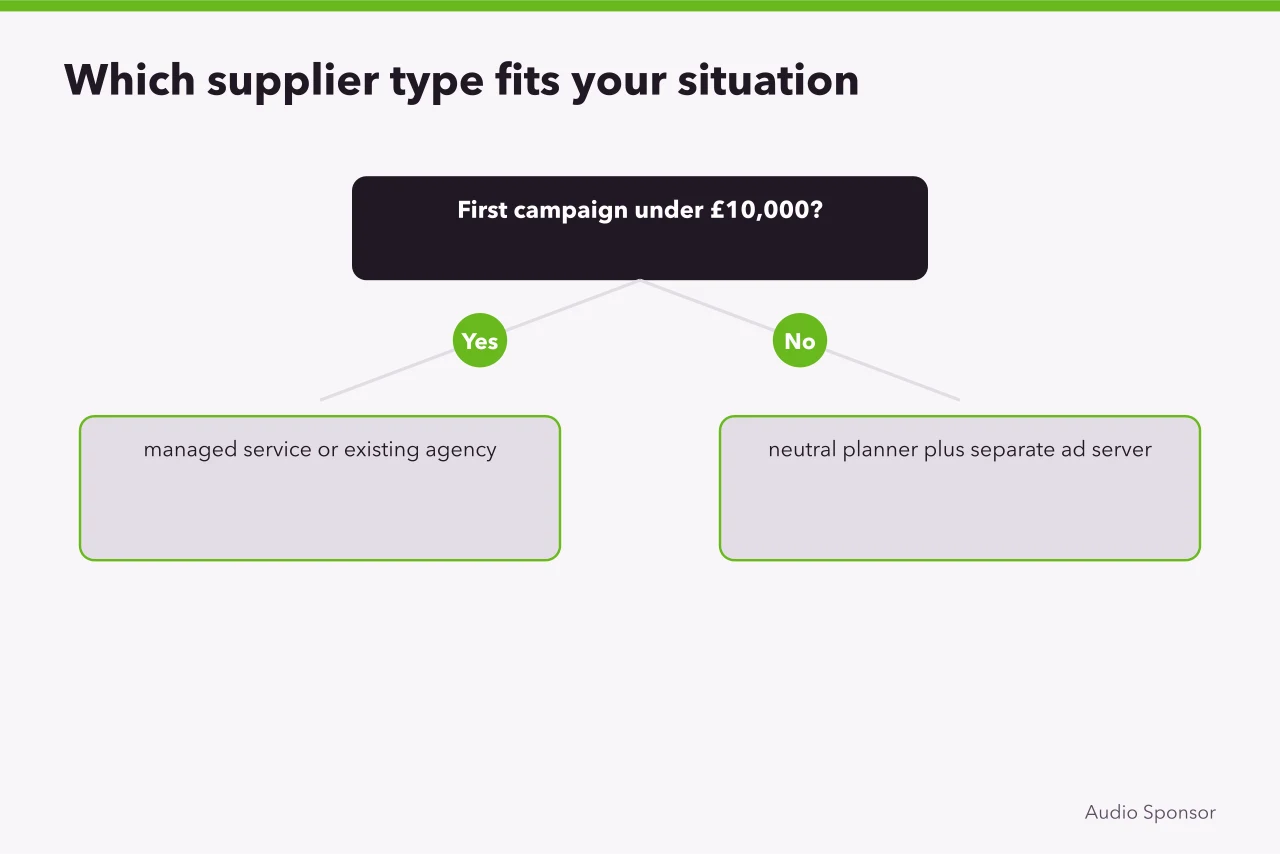
Decision table: which supplier type fits your situation
Use the table as a starting filter, then test any shortlist against your own reporting and compliance requirements.
Decision table
Choose
- First campaign, budget under £10,000 (illustrative)
- A managed service or your existing media agency
- Regular monthly spend across 20 or more shows
- A neutral planner such as Rephonic or Magellan AI plus a separate ad server
- Brand with strict compliance needs
- Podscribe or Podtrac for independent verification
- Political or cause-led sponsorship
- A specialist agency that knows the CAP code for social and political advertising
- In-house team with data skills
- A research subscription plus a flat-licence ad server such as Megaphone or Acast
- Campaign running across the UK and Ireland
- A platform with local invoicing and currency support, such as DAX or Acast
Avoid
- First campaign, budget under £10,000 (illustrative)
- Multi-year platform licences
- Regular monthly spend across 20 or more shows
- Publisher-owned tools that rank their own inventory first
- Brand with strict compliance needs
- Tools that only report download totals
- Political or cause-led sponsorship
- Generalist buyers unfamiliar with political ad rules
- In-house team with data skills
- Percentage-of-spend deals at low volumes
- Campaign running across the UK and Ireland
- Tools that bill only in US dollars
Two rows carry more risk than the rest. A brand with strict compliance needs will pay more for verification, but the alternative is discovering a brand safety failure after the campaign has run. Political work needs a supplier who can evidence how the CAP rules were applied.
What the tools cost and how fees are structured
Two models dominate for ad servers and managed services: a percentage of media spend and a flat platform licence. Acast and DAX sell on a share of the media they place. Megaphone and Omny Studio are usually licensed rather than charged on spend. Per-campaign pricing suits one-off bursts, such as a series launch.
The percentage model is simple to budget but scales badly. At £50,000 a month in media spend, a 15% platform fee is £7,500 a month (illustrative figures). The same platform on a flat licence might charge £2,000 a month, so the crossover point matters.
Ask every supplier for the fee at three spend levels: your current spend, double it, and half of it. Suppliers who cannot answer quickly usually have a pricing model that punishes growth.
Watch for minimum commitments buried in the contract. A platform priced at £1,500 a month will still bill that figure in a quiet December when nothing is running. Ask what happens to unused platform days or credits.
Payment terms are negotiable more often than the headline fee. Net 30 is standard, and suppliers chasing mid-market advertisers often accept Net 45 or Net 60. Settle the terms before the pilot ends, because negotiating pressure disappears once a campaign is live.
VAT sits on top of all of this. Advertising services and sponsorship income have specific treatment, and the GOV.UK guidance on VAT for business and sponsorship income is the starting point for checking whether your supplier's invoices are structured correctly.
Data, targeting and the rules you inherit
Audience targeting in podcast advertising often relies on data brokers who supply segment lists for planning or measurement. In the UK the names buyers meet most are LiveRamp, Experian, Acxiom and CACI. Oracle Advertising closed in 2024, removing one of the largest brokerages from the market.
Data broker compliance checks
- Broker's lawful basis
- Transparency information given to individuals
- Your privacy notice covers the use
- Data processing agreement in place
- CAP rules for political content
Using those lists transfers obligations to you as the advertiser. The ICO gives guidance for organisations using the marketing services of data brokers. It sets out what to check: the broker's lawful basis, the transparency information given to individuals, and whether your own privacy notice covers the use.
Brand safety rules are the second obligation. Most UK podcast inventory is brand-safe by default, but news, comedy and political shows need explicit controls. If your campaign touches political content, the CAP rules on social and political advertising apply, and the supplier should evidence how those rules were followed.
Data flowing back to a platform for measurement needs a lawful basis too. A data processing agreement governs how data is handled, not whether you were entitled to collect it.
Commissioning a branded series brings its own questions. The VAT treatment of a production deal can differ from a straightforward media buy, so agree the invoice structure before the first episode records.
How to run a supplier selection process
Start with a written brief covering campaign objectives, budget range, target shows and reporting needs. A brief of one page beats a deck of twenty. Suppliers respond to clarity with clarity.
Supplier selection process
- Write a one-page brief
- Shortlist four to six suppliers
- Score capability, cost, integration, compliance
- Check commercial model before final pitch
- Run due diligence and references
Shortlist four to six suppliers across the layers you need. Ask each for a reference from a client of similar size, not a logo wall. Then score capability, cost, integration effort and compliance.
Our podcast advertising software selection in England guide sets out the scoring model and the questions that separate serious suppliers from resellers.
Score references as heavily as features. A supplier that has run campaigns at your spend level for two years will handle your launch better than one with a longer feature list.
Check the commercial model before the final pitch. A supplier priced on percentage of spend will resist a flat-fee request, and knowing that early saves a round of emails.
Due diligence comes next, and it is more than checking a company number. Ask for two years of uptime reports, the data processing agreement, and the names of the sub-processors handling your campaign data. The podcast advertising vendor due diligence checklist covers the documents to request.
If you need a directory to widen the search, membership bodies such as the IAB UK member directory list agencies, platforms and measurement firms operating in the UK market.
Set a deadline for the whole exercise. Four to six weeks is realistic for shortlisting, evaluation and commercial negotiation (illustrative timeline). Processes that drift past eight weeks lose the attention of the suppliers you most want to hear from.
Implementation: what the first 90 days involve
Implementation is where most budgets leak. Every layer added to the stack adds setup tasks: tracking pixels, feed access, creative specifications and user permissions.
First 90 days implementation
- Week 1-2Contract signature and setup tasks
- Week 3-4Tracking pixels and feed access
- Week 5-6First live campaign
- Day 30Review delivery against forecast
- Day 60Check creative and tracking accuracy
Plan for four to six weeks from contract signature to first live campaign (illustrative timeline). The slowest step is usually access to publisher feeds and analytics, which depends on the publisher rather than your supplier.
Our podcast advertising tool implementation in England guide breaks the rollout into weekly tasks, including the testing that catches tracking errors before spend begins.
Staffing is part of the cost. Someone has to run reports, chase creative approvals and reconcile invoices. The ONS publishes UK earnings and working hours data that gives a benchmark for the salary cost of that role.
Build review points at day 30 and day 60. At each one, check delivery against forecast, creative performance and the accuracy of the tracking data. Catching a broken tracking tag in week five costs far less than discovering it when the campaign ends.
Train a second person on the platform. A single administrator creates a dependency that shows up during holiday periods and when that person changes jobs.
Choosing between a managed service and self-serve
Managed services suit teams without dedicated ad ops staff. You pay a higher fee, usually a percentage of spend, and the supplier runs the campaign. Acast and DAX work this way. Self-serve suits teams with existing media buying skills who want control and lower fees.
The deciding question is not budget, it is headcount. If nobody owns podcast reporting as a named responsibility, a managed service will outperform a self-serve licence.
A hybrid path works for some advertisers: managed service for the first two campaigns, then a switch to self-serve once the team knows the platform. Negotiate that route at the start, because migration fees are easier to waive before signature than after.
What to check before you switch suppliers
Switching costs are real. Feeds, historical reporting and creative assets all need exporting, and some platforms make that awkward.
Before signing with a new supplier, ask for a data export in a standard format and confirm who owns the campaign history. If the answer is vague, negotiate an exit clause with a defined export obligation.
Run both platforms in parallel for one campaign if the budget allows. It is the only reliable way to compare delivery data, and the comparison usually settles internal arguments faster than any pitch document.
Common questions
Do I need a separate ad server for podcast advertising?
Not always. If you buy a small number of host-read slots, the publisher's own insertion is usually enough. A separate ad server such as Megaphone, ART19 or Omny Studio earns its fee once you run dynamic campaigns across many shows or need region-level creative swapping.
How much should a podcast advertising platform cost?
Percentage-of-spend deals commonly sit between 10% and 20% of media cost, and flat licences start around £1,500 a month (illustrative figures). Acast and DAX sell on a share of spend, while Megaphone and Omny are usually licensed. Ask for pricing at three spend levels before you compare suppliers.
Can I use data broker audiences for podcast targeting?
Yes, provided you check the broker's lawful basis and your own transparency notices. The ICO expects advertisers to verify how data was collected and to document that check before campaigns run. LiveRamp, Experian, Acxiom and CACI are the brokers most UK buyers meet.
What is the biggest cause of delayed launches?
Publisher feed access and tracking setup. Both depend on third parties, so build four to six weeks into the plan (illustrative timeline) and start access requests on the day the contract is signed.
In this guide
- How to choose podcast advertising software: suite or separate toolsWeigh a full campaign suite against separate booking, verification and reporting tools, with named vendors, VAT rules, ICO data checks and evaluation criteria.
- Which podcast advertising tools should buyers in England shortlist?A named shortlist for England, including Acast, Global DAX, Spotify Ad Studio, Gumball, Podcorn, Megaphone, Podsights and Barometer, with PECR and CEST checks.
- Before you run a podcast advertising supplier comparisonComparing podcast advertising suppliers in England? Score inventory access, audience data, reporting rights and rate structure before you commit budget.
- How to run podcast advertising vendor due diligenceA step by step checklist for podcast advertising vendor due diligence, covering company checks, listener data, content rights and sign-off before you spend.
- Plan your podcast advertising tool implementation in six stepsA six-step how-to for podcast advertising tool implementation, covering consent sign-off, budgets, supplier checks and the sanctions regime behind UK ad claims.